

Pros. data UNICEF, the full-scale war in Ukraine has affected the lives of more than 7.5 million children. In many families, children have faced new challenges - instead of play and development, they are faced with anxiety, displacement, limited socialisation and the inability to feel safe.
Since February 2022, more than 2,520 children perished or injured as a result of hostilities - and these are only the cases that have been verified. According to the organisation, schools, hospitals and other critical infrastructure are often targeted, which directly affects children's access to education, medical care and stable space.
Evaluated by.The UNICEF report estimates that about 1.5 million children are at risk of developing depression, anxiety, and post-traumatic stress disorder. In addition, many children have lost family members or friends: approximately one in five children in Ukraine has lost a loved one to war. This adds a deep emotional burden and creates internal barriers to development and adaptation.
Despite all the challenges, children need not only protection from immediate threats, but also the conditions for preserving their childhood - space for learning, communication and development. The state often does not even undertake to meet these needs in full. That is why in Ukraine, this responsibility is passed on to other members of society. One of the most important among them is businesses that have the resources, infrastructure and ability to create safe places for children and support their initiatives.
The role of business in supporting children during the war
Business today has become one of the few sustainable institutions capable of responding quickly to the needs of society. Unlike government agencies, which are slow to act and often constrained by bureaucracy, companies have more flexibility and resources to create concrete solutions. For children, this means the opportunity to get a safe space for development even in times of war.
Businesses operating in public spaces, such as shopping and sports and entertainment centres, educational and cultural hubs, are gaining in importance. Such places already have a ready-made infrastructure where social initiatives can be integrated: exhibitions, sports tournaments, educational events. For children and adolescents, they become an alternative to school or a club, available regardless of whether their family has stayed at home or has been forced to move.
This approach is consistent with what experts call the "existential" social responsibility of business. MIT Sloan Review study shows that Ukrainian companies are transforming their CSR activities into vital social projects during the war. Business is no longer perceived as an outsider volunteer, but is becoming part of the social response system, without which it is impossible to meet the key needs of people.
Of course, this situation is not fair. Ideally, it is the state that should guarantee children's safety, education and development. But in the Ukrainian reality, this responsibility falls on business. And although it is an additional burden, business is often the force that can actually provide children with a minimum of stability and opportunities for growth. But if these efforts give a child a chance to feel safe for at least a few hours - to play, talk or discover something new - it is already worth the resources spent. Because even a short moment of peace and joy helps children maintain the feeling that life can be different from what the war dictates.
Why malls and shopping centres
Among the various business formats, shopping and sports and entertainment centres have a special potential to support children in times of war. They are already public spaces where people come not only for shopping, but also for socialising, cultural events or recreation. This makes them natural focal points for social and educational initiatives.
The infrastructure of shopping malls and entertainment centres allows for the rapid integration of projects that provide children with an alternative to their disrupted daily lives: exhibitions, sports tournaments, masterclasses, and festive events. For many families, especially those who have been forced to move, such spaces are almost the only available place where a child can feel relatively stable and safe.
In addition, due to their openness, shopping malls and entertainment centres can attract partners - NGOs, charities, children's agencies - and create systemic programmes instead of single events. This allows them to turn commercial space into a platform that really supports the community.
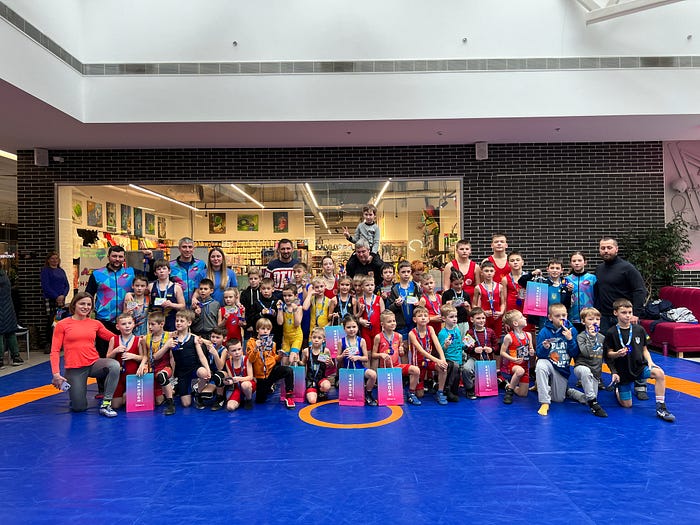
Examples of initiatives in Roksolana shopping mall and Spartak shopping centre
In our centres, we consistently integrate social projects aimed at supporting children living in the new reality of war. This allows us to combine cultural, sports and charitable initiatives within an accessible space.
Roksolana shopping centre
One of these events was the photo exhibition "Eye Contact. A Look in the Spectrum". At the exhibition, we presented portraits of children on the autism spectrum - residents of the LEVCHYK SPECTRUM HUB, a space created by the Future for Ukraine charity foundation. The exhibition had several meanings. For the children themselves and their parents, it was a way to feel proud and accepted, as their stories and images were seen by thousands of visitors to the centre. For the community, it was an opportunity to take a fresh look at the topic of acceptance and equal opportunities, to better understand the needs of children with special needs and to overcome stereotypes.
Such projects are especially important in times of war, when society's attention is focused mainly on military challenges. They remind us that there are children for whom support and socialisation are no less critical than physical safety. And it is thanks to events in public spaces that this topic becomes visible to a wide range of people.
Spartak shopping and entertainment centre
At Spartak, we regularly run initiatives to support children in wartime. Among them:
- a charity exhibition dedicated to the stories of children affected by the war;
- Spartak wrestling tournaments to help young people develop in sports;
- a charity event for Children's Day for internally displaced children, organised in cooperation with the Dante Kids agency (animation, science show, gifts);
- the My Heroes Defenders campaign, in which children received gifts for their drawings.
These initiatives demonstrate that even in difficult circumstances, shopping malls and sports and entertainment centres can be places where children find support, inspiration and a sense of normalcy.
Our position
Our experience shows that even simple events such as an exhibition, a sports tournament or a children's party can give children a sense of security and give them back a piece of normal life. These initiatives are small in scale, but they have a tangible effect: children gain positive experience, parents feel the support of the community, and society sees that the future generation is being taken care of here and now.
It is important for us that Roksolana and Spartak remain such spaces - open for cultural and sporting events, accessible to families with children, and ready to cooperate with charities and organisations. This is a systematic work that we plan to continue in the future, as we understand that in wartime it is no less important than the economic activities of business.
We also hope that these examples will serve as a signal to other companies. Businesses in Ukraine today have a unique opportunity to show that their role is not limited to a commercial function. The ability to support children and create a safe and friendly environment for them is a contribution that has a lasting effect and helps the whole country.
The future after the war will depend on how much we preserve and support those who are most vulnerable today. And if business can provide children with the opportunity to develop and feel for a moment like they are in a familiar, peaceful world, this responsibility is worth every effort.


